Monday, December 19, 2016

2 year ACL surgery anniversary! @ UCSF 5K Holiday Classic

It's December already. And that means it's 2 years since ACL reconstruction surgery on my left knee (Dec 17, 2014). These past few years have been a rollercoaster, career-wise, relationship-wise, and in my running journey. This blog has sort of evolved as an outlet for my dreams and thoughts, but most predominantly, things related to an "active lifestyle."

It's crazy to think that I was in crutches two years ago and now people have said I'm "so in shape" or that I'm a "fitness junkie." I don't try to get these labels.. rather, I actively try to avoid them. But I'm fortunate, nonetheless, that my "obsession" (preferably, read: passion) emanates that way.

It's been an interesting fitness/running journey this past two years. A lot of downs... but a lot of ups as well. Let's focus on how amazing the ups have been:
  • a job I enjoy that allows me to be flexible with my hours for training
  • first road bike
  • my first double digit training run, and then the second, and then a weekly thing!
  • finishing my first half marathon, a sprint triathlon, and then a second half marathon
  • PRing the 5K and 10K distance
But the biggest lessons I learned?
  • Consistency is key.
  • You don't have to go goal pace all the time!! In fact, you're likely to get injured if you do...
The year ended with an awesome 5K race for the UCSF Diabetes Center (all proceeds go to the Diabetes Center and is completely run by volunteers). The course was USATF certified which is pretty nice, since I know this is an official distance (unlike those Berkeley Half shenanigans!).

Honestly, I didn't know what to expect for this race because I'd done all of my training at MAF intensities up to this point (besides racing).

I did WAY better than expected and felt stronger than I thought I should have by the end. You guys, this is a HUGE personal record, beating my high school cross country time by 30 seconds. At 22:44 (7:19/mi pace), I think it spoke volumes to what LHRT/MAF has done for me. I went out to fast again, but honestly, I also think I could have pushed harder in that second mile. The second mile of a 5K, as it turns out, is a highly mental game. It was even more challenging given that the course has a few gentle hills going around Stow Lake. According to my Garmin/Strava, I blasted through the first mile split at 6:59 then slowed down to 7:31 in the second. I think... I just got lazy. For a 5K, you have to be mentally present for all 20+minutes of the game. Your legs have to be moving fast and your willpower has to be tough. I saw some females pass me and just thought... well, I'm not as fit as her, so I don't need to push myself so hard and ANYWAY, I still have 1.5 miles left to go! I know, WEAK. But despite having raced quite a few races this year, I still feel quite inexperienced, especially in the mental toughness department. In my opinion, LHRT definitely did not prepare me mentally for the second mile, but it did physiologically prepare me for the last. I found a kick in the end and finished strong.

Anyways. DESPITE THAT. Like I said, I blew away my high school PR (formerly 23:15 and even then, I'm not sure if that was a legit time... since there is no record of it online, as hard as I've searched) and the adult PR I set at the Giant Race earlier this year (23:36 @ 7:35/mi). I came in 2nd in my age group (F20-29) and I think 6th(?) overall female in a field of about 106 (22 out of 174 overall M/F). Results posted here: http://www.synergyracetiming.com/ucsf-diabetes-center-miracle-mile-5k/.

All that without intervals or high intensity work. I averaged about 25-30 miles per week with all of my training paces at 9:00+ minutes/mile (many closer to 10:00/mi)! The time is about where I think my road surface MAF was at the time... which was about 9:30/mi. The best part is: NO INJURIES!

I think it's enough proof for me to trust this method for another few weeks. Some day soon, I hope to break the 5K 7:00/mi average pace barrier (21:38)... but there's still 2 months of low intensity miles and base building left! Maybe I'll do a 5K as an official reintroduction to higher intensity work when the time comes.


P.S. I've run 1000km so far in 2016. Isn't that insane???


P.S.S. ALSO, my boyfriend ran his first 5K coming back from clavicle surgery. While the surgery didn't affect his legs, it was his first invasive surgery and it's been taking a lot mentally to get back into a health and fitness regime. He ran it at 8:08 pace which is pretty awesome for only running once a week leading up to it! I'm just glad to have my life partner back on his feet again :).

Sunday, November 20, 2016

Berkeley Half Marathon 2016: lessons in rain and pain


So, I didn't reach my sub-1:45 goal. It was a PR but I didn't even break 1:47, which I think I was completely capable of. And that really sucked.

I think that I'm okay with the results, though, because I've never had a really "bad" race before and I think all distance runners need to have bad races before they really figure out what works for them and what doesn't. Here are a few big things I learned yesterday:

1) I tend to start out very fast. And the problem is that it feels. so. good. Especially after a taper... you just have that spring in your step! I'd read SO many articles about how you're not supposed to start out too fast for endurance races and I honestly thought I was holding myself back. But the first half of Berkeley is insanely hilly and puts you at risk for anaerobic burnout. Going out fast for a 10K or 5K works great but endurance races are a no, no. On the other hand, I PR'd the 10K distance (in a race setting) with a sub-8 pace (official time 47:48, 7:42 pace), which I'd been trying to achieve for a long time. And I ran myself into an unofficial sub-8 paced 10-miler as well!

2) The other problem I had was it was mentally very difficult to dig deep despite the fatigue from starting out too fast. Again, I'd read that the last 5 miles is where the 13.1 distance really becomes a race, and I thought I really had it in me. With my LHRT (low heart rate training) regimen, I practiced a fast finish only once and a semi-brick tempo 5K off of a 30mi ride on the bike. This, and the fact that I had raced often in the past gave me the confidence that I had the mental fortitude necessary to pull out a reach goal.

But reach goals are difficult. PRs are difficult. On a challenging course (550ft elevation gain) in tough conditions (cold and rainy), you've got yourself one hell of a race. And when the 1:45 pacer passed me near mile 10, I felt extremely discouraged. I really wanted a good time. I tried to dig deep. I tried to move faster by quickening my stride rate but all my legs could give me was an 8:30-9:00 pace. It didn't help at all that the last 3 miles are very slightly uphill. Making my efforts for pace seem a LOT more grueling.

Discouraged, I decided to walk a couple of times in mental defeat. I didn't need to walk but I ended up doing so, thinking that it would be enough to regain my composure. Re-composure never happened and, post-race, I hated myself for walking at all.

If I couldn't get 1:45, I could have at least tried for 1:46:xx. Alas... this is why you should have B goals and C goals. If I had believed in a B or C goal, I would not have walked and I would have gotten an even better PR. If I had believed in a B or C goal, I would have realized that some things like weather are just out of your control and you have to give yourself the best that you can. It's especially difficult to prepare for inexperience, which was probably the biggest obstacle I had this race.

It isn't all bad, though, because I believe that a race like this will give me the extra push I need in the final minutes of a race, regardless of whether or not I'm close to my goal time.

3) Finally, a note on the month of training I did at low heart rates:

LHRT gave me the ability and the spirit to train more consistently. On that alone, I was able to run a 5K only 4 seconds slower than the Giant Race I did in September AND I ran my fastest 10K to date, without it hurting at all. I can only imagine how much faster I've gotten at those distances.

In all, I think 4 weeks of LHRT was not enough training to build up my endurance for the full half marathon. The ramp up in weekly miles was great but I didn't stay at a high mileage for very long before the race, which meant, frankly, there wasn't enough aerobic conditioning past the 1 hour mark.

My plan for the Big Sur International Marathon is to make sure all my runs go a minimum 60-75 minutes during base building phase in addition to the Sunday long run and a mid-week, mid-long run (>90 minutes).

4) Other notes I made for myself:
* more aerobic strength and vLT training needed
* be prepared for sudden course changes (I have no idea why they changed the course but it was not what I was expecting so my race strategy got a bit thrown off. As a result, I think the course ended up being maybe 0.1-0.2 miles short, which contributed to my official PR... but I'll take it since I'm confident I can beat it the next time I run a half.)
* practice running in the rain and various different weather conditions (this will come with consistency)
* could still stand to lose a few lbs (at 123-124 now)


All in all, a humbling race and one that will keep me focused for the many months to come before Big Sur. Here I go!

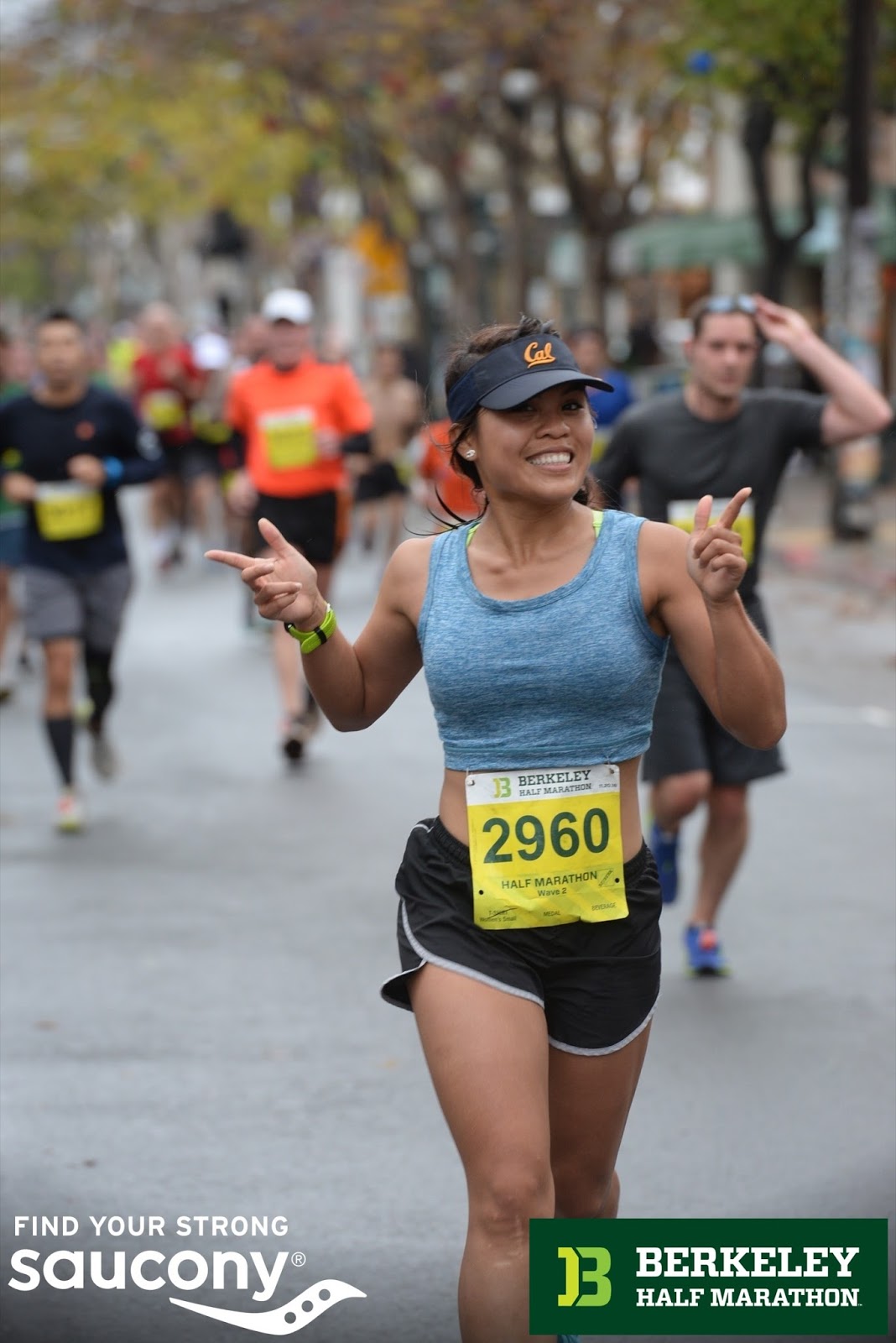
ALSO. I am getting better at taking race photos!!


Tuesday, November 15, 2016

Crazytown week and pacing experiments

Taper week is driving me crazy!! Since I started running consistently the past month, the thought of taking more than 1 day off from running really gives me the nerves - and I've planned pretty much total rest (brisk walking is aiite) on Tuesday, Wednesday, and Saturday... I've never felt so wound up before. I just want to run the race already so I can get back to my regular programming. This week is particularly stressful, too, because of a group project in my physio class and some deadlines at work. Argh!!

Maybe I feel like I didn't train very hard EVEN THOUGH it's probably the most miles I've ever run (or biked) in a single 30 day period. Although I've tested how it felt to run at different pace intensities, I'm still racking my brain because I haven't run at goal half marathon pace for more than 1-mile at a time. Of course, as I described before, there's a reason for that. I've just been building volume and I never intended to take the Berkeley Half seriously anyways. Being competitive old me, competitive with myself, the thought of not giving it my all, even when I feel so strong now (structurally, at least), I'm pressuring myself to perform and prove that my experimentation with high volume actually works.

But anyways...

Since receiving my Garmin Forerunner 235 (as a wonderful wonderful birthday gift from Marvin), I've bought into the theories of low heart rate training. I won't go into to much detail here because the best starting point for anyone would be this article here: "Want Speed? Slow Down!"

The gist of it is I used a very simple formula to find the heart rate I should rarely, if ever, exceed during my runs.

Maximal Aerobic Function HR = 180 - age

For me, my MAF HR is 154bpm but I've been aiming for about 150bpm most days because my breathing rate feels easier and it's also easier to prevent my heart rate from jumping at that effort. I allow for 154 when going up the unavoidable hills and inclines of San Francisco and Daly City routes.

Dr. Phil Maffetone suggests training at this heart rate exclusively for several months but I've mainly tried to keep it at 80-90% of my training. So I've more or less been following an 80/20 or 90/10 rule (80%-90% easy and 10%-20% at moderate-difficult efforts).

I still also have a long way to go in regards to cleaning up my nutrition and fueling habits. But I feel like I'm getting there. :)

After one month, I've noticed a few subjective side effects:

1) I enjoy running/jogging far more -- It's absurd how many days this month I've gotten out of bed excited to get a jog in or sad that it's rest day. I'm no longer tired after every run. I look forward to each run more than I ever have before. I never thought this was possible, given I'm a bit of a masochist and enjoy the feeling of a hard workout. But this method really makes me want to get out of bed in the morning to get a 10 miler in!!

2) I value the rest day and my structural fitness. Sleep and recovery are a lot more important to me, which in turn helps me bounce back from long run days quickly. If there's one most important I've taught myself over the past months, it's that fitness gains don't happen during the workout. They happen after the workout, and most importantly, while you sleep.

3) Slowing down taught me to honor my body and avoid injury and overtraining. It was easier for me to listen to my body and notice twinges and aches before they became full-blown injuries. This allowed me to foam roll, hydrate, stretch, strength train, or do whatever I needed to do to prevent ITBS or my previous knee/arch issues.  My body was able to take prolonged low intensity beatings without tearing apart and I upped my weekly mileage quickly. I also learned when my body needed easy/rest days. For example, after the speed workout I did with NRC, I was noticeably exhausted for 2 days (despite feeling wonderful and fresh the night of the workout). So I did an easy day on the bike and a SUPER easy 5K the second day (~140-144bpm). I also napped during lunch breaks. Because NAPS.

3) My form seemed to improve. By slowing down, I had a lot more time to focus on correct form and cadence. And I felt WAY more efficient as the weeks went by! My average cadence on most training days fell naturally at 176 spm but seems to trend upwards over time on fresh days. (On recovery days, I don't pay attention to cadence as much - mostly because I feel like a slug.) When I tested my race pace intensities, I easily went to 180 spm and, unless fatigued, I don't overstride.

4) Despite the benefits of jogging slow, I was also always worried that my low speeds would make me slower :(... still, I had to proceed  FOR SCIENCE! Since there have been no race performances to reflect any improvements, I can't exactly "trust" the process just yet. I do vehemently believe it has made me a more structurally sound runner, though. And more consistent. I just feel guilty that this has not been a pure Maffetone experiment as I could not let myself do away with speedwork and tempo work.

Anyways... the objective side effects:

The MAF test results

10/13/2016 3 Mile MAF test
3mi MAF test, 9:42(149bpm), 9:39(149bpm), 9:40(149bpm) 54F

11/13/2016 3 Mile MAF Test (monthly check-in and pre-race test)
3mi MAF test, 8:50(149bpm), 9:02(149bpm), 9:20(149bpm) 63F 

After just one month, at the same heart rate, on the same track, in warmer conditions, I ran my the first mile of the test 52 seconds faster!

I had a very weird 1st MAF test in October where I didn't really fade in pace. Normally, you should fade because of cardiac drift and fatigue. I warmed up for 2 miles before starting the test, so I'm unsure what it was - maybe because it was cold or maybe I warmed up too long? IDK.

Until my next test, I'll just be happy with the improvements I've shown in just one month.

The theoretical MAF race correlations:

MAF    5K   5K   HM   marathon
min/mi pace time time time
10:00  7:30 23:19 1:50 3:53
9:00   7:00 21:45 1:42 3:37
8:45   6:52 21:22 1:41 3:34
8:30   6:45 20:58 1:39 3:30
8:00   6:30 20:12 1:33 3:17
7:30   6:00 18:38 1:26 3:02
7:00   5:30 17:05 1:19 2:47

When I started circa a MAF pace of 9:42-10:00, the 5K time and half marathon times seem to correlate well. My 5K on a flat course was 23:36 (Sep 2016) and my HM (~350ft elevation gain) was 1:49:38 (July 2016). 

I'm hoping that my last MAF test was not a fluke because it would be awesome to get a time closer to the MAF prediction. The Berkeley course is tougher with ~550ft of elevation gain but I hope my newfound strength can make up for it.

Another note: my Garmin's race predictor is interesting. According to my Garmin, I have a VO2 max around 49-50 and I'm capable of running a sub-1:40 =_=. Hah. A girl can dream I guess.

Friday, November 11, 2016

"We never lose our demons, we only learn to live above them."

I can't pretend to understand the gravitas of this year's electoral college and many others have voiced their opinions much more eloquently than I could ever hope. However, I've felt a certain pressure to say something when I read the posts of all my friends. I do have an opinion and I do have the option of resonating it on places like Facebook and Twitter and whatever. But I suppose I've taken a more removed stance on what's going on around me. So here I am on Blogger, where probably only two other people read this regularly, in the hopes that I can retain the memory of the fire I am carrying right now.

On election night, I watched my friends on Facebook shoot out things like "Oh, Canada" and "Why, America?" and instead of getting angry about the election results, I just got angry at what I was reading. I even chided my boyfriend for just joking about moving to Canada and for "not understanding" what was going on.

We should understand it completely. I may be somewhat of an idealist but at least I know that the world is not isolated to our California bubble. The symptoms of a divided America have always been there. Racism, sexism, misogyny, anti-LGBT sentiments have always. been. there. At some point during our social progress (and what exactly is "social progress" anyway?), corruption and fear (mostly fear) will inevitably come out from the shadows.

Again, I can't pretend to fully comprehend all that goes on. But if there's anything I learned while being abroad for nearly 3 years, it's that all the things that Trump represents in the eyes of democratic America (racism, inequality, misogyny, greed, etc.) exist because they are byproducts of human nature. They are convoluted representations of a basic human need for self-preservation.

But there is more to human nature. Juxtaposed to all the jokes about booking the next plane out of the U.S.A. and the severe disappointment with the American populace, there is a very real call for love. Some of my Facebook friends are urging Clinton supporters (or anti-Trump folks) to move forward, have empathy, reminding us that it's only a 4-year term and that there are still many things we can do at this point.

As long as we are here and as long as we have voices, it's our responsibility to use our privileges to make a difference in this world. And we can't do that by turning our back on America, or most importantly, the people in it -- even those who have voted for the 2017 president-elect (reminder: that's nearly half of those who voted in the general election...).

My entire life, I've told myself that we cannot turn our backs on our problems or our communities. We cannot run away from them and try to find our own utopias. Certainly, a utopia (or something close to what you believe is an ideal society) can equip us with the tools and ideals to model our actions towards but, at some point, you must return.

If there's anything good that came out of the general election, it's this: that we might no longer expect the oozing political complacency plaguing many millennials, myself included. As a nation, the viral infections of hate and fear have felt asymptomatic (with the occasional outbreaks reported by mass media) up to this point. But perhaps we reached the fever pitch as the election shocked reality back to the surface.

As the Ancient One once said: "We never lose our demons, we only learn to live above them." (That's a Dr. Strange reference.)

As for me: I was once complacent. But this election could serve as an impetus for me to understand the world. And, idealistically, I remain steadfast with the belief that I can change it in small ways that add up to bigger ones.

Forward.

Sunday, November 6, 2016

No injuries this training cycle = success!


Wow! It's been one heck of a training cycle before the Berkeley Half.

I haven't been very race-specific given that I've treated this race as more of a springboard and baseline measurement for my marathon training. But this is certainly the first time I've trained consistently before a race (even if it's just been 4-5 weeks). And that is something to be proud of.

Naturally, I have high hopes for the Berkeley Half. But I'm nervous because I spent the majority of my training at low heart rates. I actually planned to experiment with 4 weeks of training at low heart rate exclusively. However, I figured that since I was injury free at my peak week of 33 miles, I might try a few tune-up workouts with a little speedplay at HM goal pace.

Quick summary of my weekly miles:

Planned mileage for the next 2 weeks are denoted by a lighter color and mileage range. 
As you can see, I dismissed the 10% rule... with reckless abandon AND this doesn't even reflect all of the cross-training I've done on my road bike (hint: it's a ridiculous amount of hours given how busy I am...). I've had four quality long runs and four consecutive weeks of 20+ mpw.... It's a miracle I'm not injured!! (*knock on wood*)

Lack of injury tells me that I'm doing something right by pegging the great majority of my runs as easy runs. And by easy, I mean truly easy (HR<154bpm, ideally <150bpm) @ 9:40-10:00/mile on the flats and even slower on hills. About 50% of my runs in October were fasted morning runs at this low intensity with the intent of training my body to efficiently use fat as a fuel source. This is my spin on the Maffetone Method.

... we shall see in two weeks if I can squeak out a sub-1:45 HM, a longstanding goal of mine. It's completely possible I'm not there yet, especially with respect to the hills.... but it's also possible that I am there! I've just got to trust my training and have fun!

Taper weeks commence! See you soon, Berkeley!


Oh, P.S. I think one thing that has really helped is logging my runs on Strava (see my training log here). It's almost unhealthy how obsessed I've been with the stats (mostly just building mileage). The old me (before I started taking marathon training seriously) would be worried that my followers will think I'm a slowpoke because I'm doing all these easy runs. But low heart training has no ego - and it will be the race results that really count.

Monday, October 17, 2016

Juggling Life: Stepping back to look at the big picture

Disclaimer: Total "all about me" post impending.

I realized while I was chatting with my boyfriend after an essay exam describing the cardiac cycle in Human Physiology... that I'm juggling a whole heck of a lot of things.

"Working full-time, taking a class, training for a marathon, and maintaining my important relationships is HARD!"

God, for all the times I've ever felt inadequate and paralyzed in my life... I never stop to realize how much I'm accomplishing just by doing things. I was talking to a classmate of mine and describing my life story: how I was born and raised in SoCal, went to community college, got a scholarship to get my undergarduate degree in Chemical Engineering in Hong Kong, paid my own room and board through tutoring and played basketball on the collegiate team (lucky stroke, I guess), got my Masters degree from Cal/UCSF in Translational Medicine (a program that trains engineers, clinicians, and the business-savvy to take technology from benchside to bedside), and am now working at UCSF as a research coordinator/project manager en route to a potential startup that uses machine learning to predict cardiac arrests in the intensive care unit. It's not a perfect story as there were definitely hardships and obstacles and things I could have done better or even embraced better along the way (there still are). But DAMN. Am I lucky to have such a rich life, or what?

I stop, though, for a second and I think:

"To the outside world, I must seem extremely unfocused--doing so many things at one time and going so many places with so many different focal points. Maybe for other people, they need a straightforward trajectory. But me? I guess I've always needed exploration. I've always needed to throw a bunch of dots on the wall, albeit loosely connected, and paint a picture that way."

So that's how the whole life cartography (the title of my blog) thing comes in. That's me. I am mapping out my own life, my way. Maybe I'm just a free spirit that acts caged. Or I'm a caged spirit trying to sing. Whatever is happening, I've only begun to scratch the surface of the final masterpiece of life....

The following is an attempt to illustrate the current picture of my life:

Big themes:

  • Sports and athletics, specifically, rehab from personal injury or self-imposed limitations.
    • As reflected with all my previous posts which are ALL race reports, my current obsession is in the form of marathon training and cycling training. I'm constantly trying to take my training to the next level but need to be patient with aerobic training and injury prevention. My current foray into training involves low heart rate (Maffetone-influenced) pacing to build up my aerobic base.
    • I'm currently taking classes that will help my fulfill the pre-requisites for PT school. So far, I've finished a Human Anatomy course (A) at CCSF and am working on a human physiology course. Here are the current requirements for the SFSU/UCSF DPT program: http://ptrehab.ucsf.edu/prerequisite-coursework. I'm taking this, literally, one class at a time. But I will be taking a break from it next semester (if I feel like I can handle it, I will be taking a SQL database course instead). Ideally, I'd love to be the first dual degree PhD student in the DPT program, but I would also aim for the Northwestern dual degree program in DPT/PhD (Eng): http://www.feinberg.northwestern.edu/sites/pthms/admissions/dpt-phd/index.html
    • I feel like in order to "fit in" with the PT school stereotype, I need to finally achieve some of the lofty goals I set for myself: specifically, a sub-8 pace HM and a BQ Marathon time. LOFTY. But why set the bar any lower?! What is it that they say: "Shoot for the moon, even if you miss you'll land among the stars."
    • In addition, I'm finding it hard for the extrovert in me to break out of the safety of my "I'm a nerdy engineer" shell.
  • Healthcare technology/Bioengineering/Data science/and All things nerdy.
    • I'm neglecting this quite a bit in my distractions with running and cycling. But I do feel like these things are a part of me. As mentioned, the classes are taking quite a bit of my commitment to work and research. Next semester, I will be reinvigorating my dedication to that.
    • Data science: it's a love-hate kind of thing. I sort of just "fell into it" and so I never have had formal training. But I feel like I'm the person who could understand complicated patterns in healthcare. Specifically, EMR. But I think I could stand to learn more about physiological signals.
  • Other goals in life:
    • Volunteer mission. Before going to PT school, I want to volunteer my time in either my parents' country: the Philippines or another country (Nepal?) on a mission to improve sports education and physical therapy there via health programs, improved and affordable technology, and a better EMR system.
    • Before the volunteer mission, I need to volunteer time in a dream PT clinic that will teach me the specific skills I need to learn.
    • Learn Chinese. Ugh. I wish I had learned Mandarin when I was in Hong Kong. But it's nothing an immersion program couldn't solve? And maybe I could manage my mission in Hong Kong? I DON'T KNOW.
    • Maintain a happy, long-lasting, mutually supportive and dedicated relationship. (Come now, who doesn't want this?)
What's next?:
  • 5 year plan:
    • Y1.25(remainder of 2016 and 2017): 
      • finish physiology class
      • personal athletic goals 
      • learn more data science and physiological signals.. co-author 1 paper (EMR-related)
      • superalarm development (startup?)
    • Y2+3 (2018, 2019)
      • work.. co-auther 2nd paper (physiological signal related)
      • volunteer mornings at PT
      • network and meet more PT and find more tech related to PT
      • develop volunteer mission plan
    • Y4 (2020)
      • work work work
      • volunteer mission! (3-6mo.)+language immersion (1 mo. or simultaneous)
      • apply to PT school/PhD Eng
    • Y5 (2021)
      • PT school!!
    • Y10.... be the director of a full-fledged neurorehab clinic. :O
Okay. So the dreams are lofty. But now that my crazy far-out ideas are here in the electronic abyss... maybe it will happen. Maybe I'll be unashamed or I'll learn how to be unabashed on my ideas in life. Maybe it'll go faster or slower than the 5-year plan proposes. But wow, I'll be 31 by then.... hey, if that's what it takes.

Everyone arrives... when they arrive.

Monday, October 3, 2016

Bridge to Bridge 5K (San Francisco Originals Series) Recap


"Race season" is almost over and it's one to be proud of.

Sure, I didn't reach many of my loftier goals (sub-8 race paces are still taunting me) but I finished my first half marathon, finished my first sprint triathlon, and PR'd my high school 5K distance. All within 2 years of my ACL Reconstruction surgery. I am a bona fide badass when you put it that way!

The Bridge to Bridge 5K was not completely flat with 91 ft of gain and a not insignificant hill in mile 3. Compare that to the flat and fast Giant Race 5K and any attempt at a PR becomes a lot more difficult. Strava failed to record my run so I'm only left to guess what difference the elevation gain made. Despite feeling stronger this race, I ended up finishing 50 seconds slower at 24:26. I also did not start near the front this time so I ended up weaving a lot more.

Pre-race support was a little lacking with Bridge to Bridge but I find this to be true of many charitable races (n=3). However, I liked that Bridge to Bridge was willing to mail their bib to you--especially since they were not giving out technical shirts for this race. I didn't mind the lack of shirt because anything to increase the amount that actually goes to charity, right (Special Olympics Northern California)? I was quite happy with some of the swag they did pass out (Oral-B Glide earphones x4??? and floss!). Finally, the SF Originals Series medal, which I didn't find too appealing from the promos, was actually a lot cooler in person.


Here are my times from the SF Originals Series:
Perhaps opting to do the "San Francisco Originals" run series was one of the things that pushed me to keep going despite setbacks and stress injuries. I've learned to train smarter and with more discipline (like running slower on easy days and warmups). Because of the series, I set a bunch of high baselines for myself. With a little more work, I will be breaking 8:00/mi in the longer distances next year. :) 

My final event of the year will take me back to my Bay Area roots at the Berkeley (<3) Half Marathon.

DOMS is setting in big time since my second half century bike ride right after the race... >_>